
Bài báo khoa học 2
Direct method for analysis of prestressed concrete structure
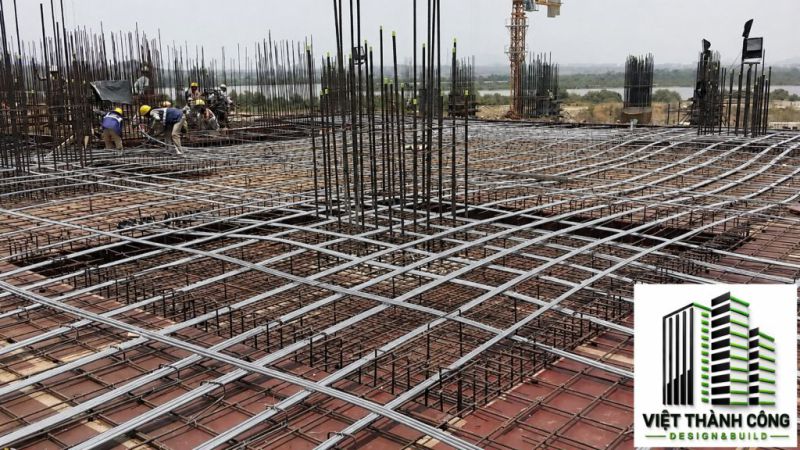
One of significant progress of construction industry is prestressed concrete. The range of applications is very wide in the high-rise buildings, prestressed concrete floor (sàn dự ứng lực) and the bridges. Prestressed concrete has been successfully used for small as well as large projects over the last sixty years. The efficiency stems from being able to use high strength materials, to structurally utilize the entire cross section, to vary the force and location of the reinforcing to best resist applied loads, and to control the timing of when the prestressing force is applied to the structure.
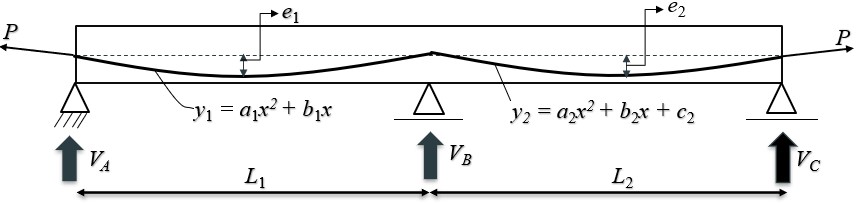
In prestressed concrete structures, load balancing is an indirect and familiar method for analyzing prestressed members through equivalent load. The frame being subjected to equivalent load produces balanced moment or prestressing moment (it is taken into account in serviceability limit state) and reactions; then, secondary moment (it is taken into account in ultimate limit state) is produced by reactions. The paper presents a direct method for analyzing prestressed members by solving the differential equations of the elastic linehttp://DOI: 10.14359/11893. These differential equations consider the equilibrium of the reactions and eccentricity of the prestressing force. After solving these equations, the engineers can directly obtain the reactions; and subsequently, determine the prestressing moment, secondary moment and shear force. The direct method also finds out the precise effect resulting from large tendon sag in transfer or deep beam. Effect of large tendon sag is the same as small tendon sag, the differences are very small. Besides, in this paper, the equivalent load models associated with any complicated tendon profiles which are formularized deal with and expand the unconventional tendon profile in the future of construction industry.
Significance research
In prestressed concrete structures, prestressing force induces two effects that are the axial prestress and eccentricity prestress; and to take eccentricity into account, load balancing was introduced by T. Y. Lin or Moorman (Moorman called equivalent load) as a simple yet powerful alternative method for analyzing prestressed members, it has been unique to calculating the effects of prestressing force on members for 60 years. In this conventional method, B. O. Aalami further presented, the tendon is removed from its duct and replaced with the forces the tendon exerts on the structure when in place as well as a constant compression force. The replaced forces are comprised of upward and downward forces resulting from the tendon profile, called equivalent load, or balanced load. The frame being subjected to equivalent load produces balanced moment or prestressing moment (it is taken into account in serviceability limit state); then, secondary moment (it is taken into account in ultimate limit state); and support reactions are calculated directly or indirectly through prestressing moment. First, the effects of axial loading and the flexure due to prestressing force are independent from one another; therefore, the general behavior must be considered individually . Second, this method must be accepted that the eccentricity of the prestressing force is small in comparison to the span and the studies about prestressing force is large in comparison to the span, on the other hand the large tendon sag has not investigated adequately or referred to in documentaries, standards. Third, for the tendons have cubic or any complicated profiles, a basic theory about equivalent load need to make clear in this cases. Fourth, load balancing method does not consider the effect of frictional loss. In reality, tendon force profile varies along the length of the tendon due to the frictional loss and in order to overcome this an average applied force (approximate force) on the member is replaced. This is the limit of the load balancing method.
Conclusions
Based on this method and its results, the following conclusions are drawn:
- The direct method provides more general way for analyzing prestressed concreate structures. The equivalent load models associated with any complicated tendon profiles which are formularized deal with and expand the unconventional tendon profiles. The consideration of frictional loss carries out based on this method, when the prestressing forces along the tendon(located x) are the function thus the equilibrium is taken Px directly not replaced force (approximate force) in conventional method.
- This method accept that the eccentricity of the prestressing force is both small and large in comparison to the It finds out solution for the large tendon sag in transfer or deep beam.
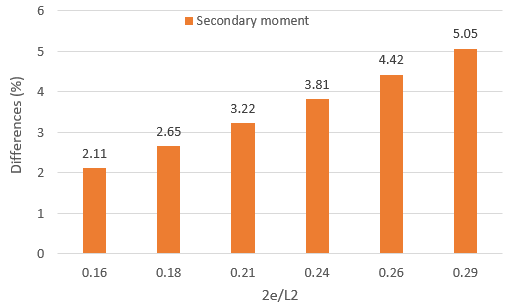
- The single-span transfer frame with large tendon sag is investigated, the differences between small and large tendon sag depend on tendon sag, the stiffness of column and transfer beam. However, the differences are small. When ratio eccentricity e and clear span L (2e/L>0.2) is the difference of secondary moment more than 5%.
Entire Paper
In order to read entire paper, download VNUHCM Journal of Engineering and Technology: https://doi.org/10.32508/vnuhcmj-et.v9i2.1489